
Rotunda Museum
Museum In Scarborough, North Yorkshire
Photogenic museum with geological interest and eclectic items dating to Georgian times.
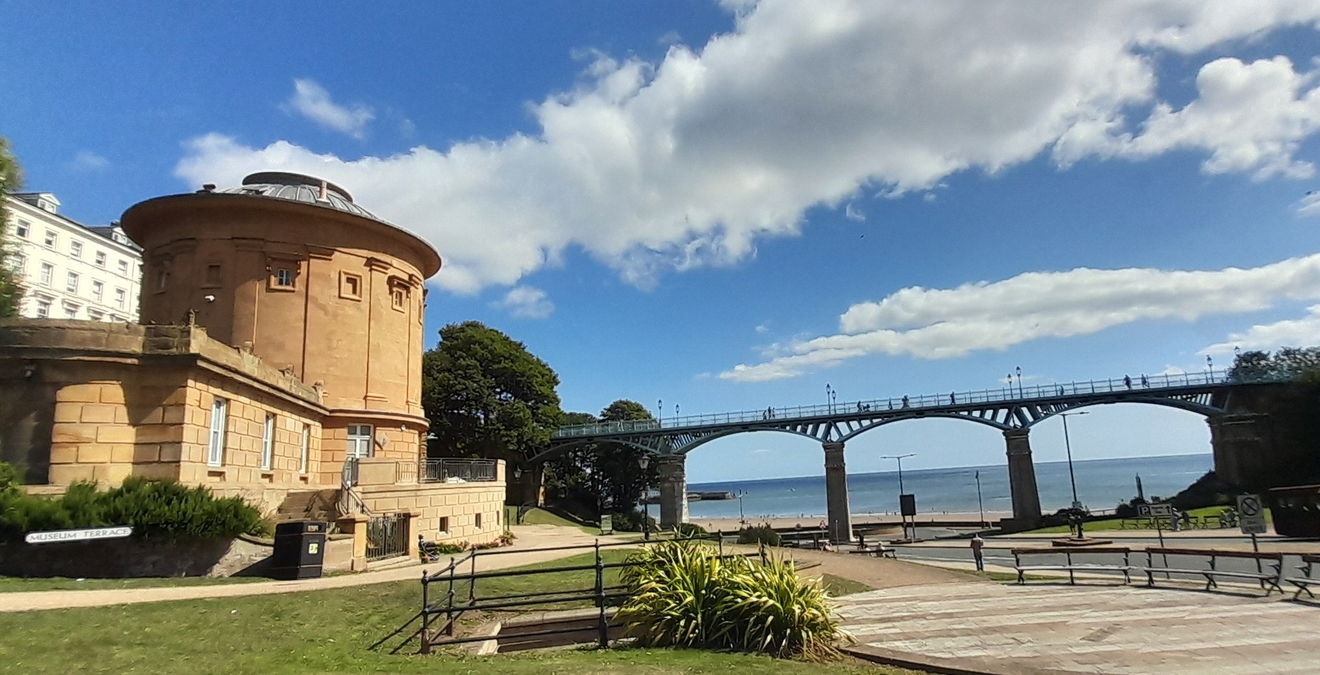
A leisurely stroll around the South Bay area of Scarborough brings you to the visual delights of the Rotunda Museum, set against the South Bay and Cliff Bridge, which can be explored in another post.
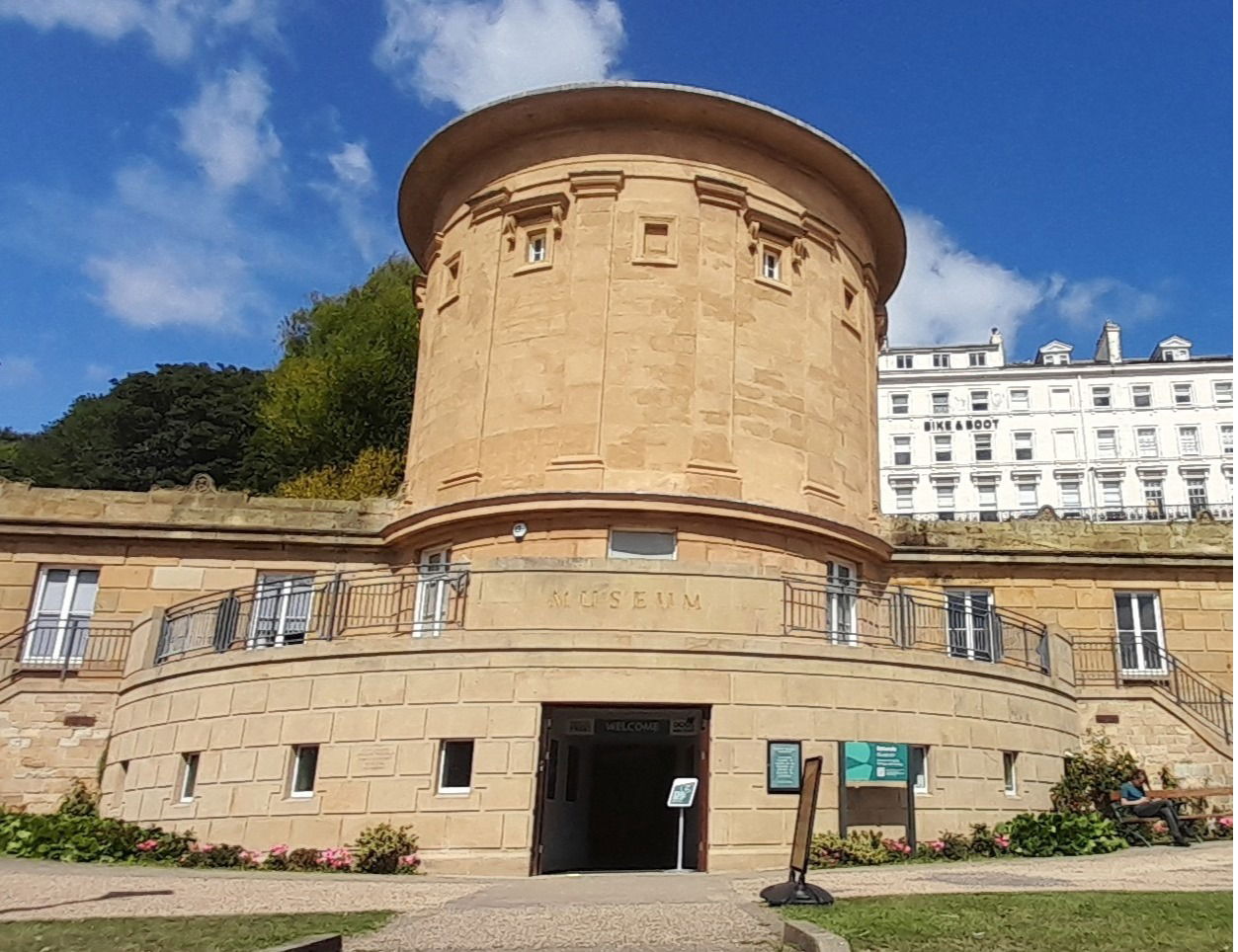
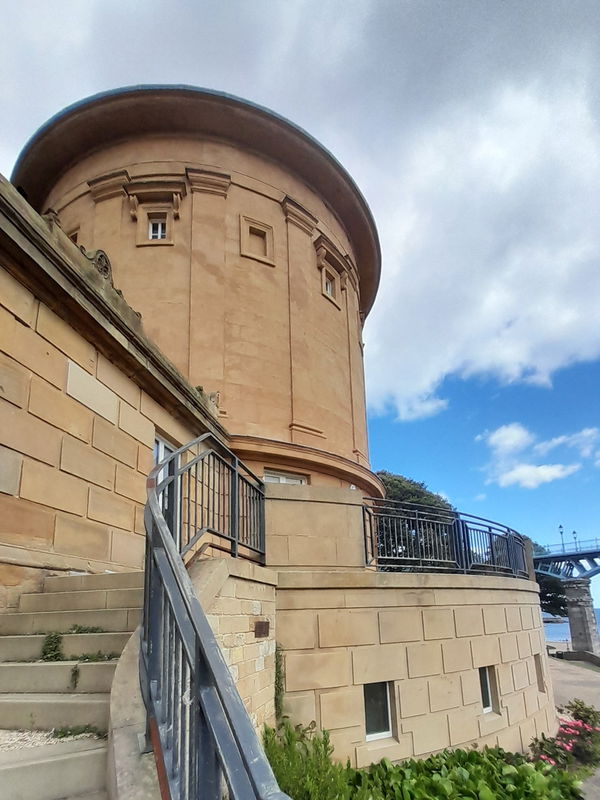
The building presents a photographic opportunity, with pleasing curves and a soft, sandstone ashlar appearance. It was a purpose-built museum that opened in 1829, at the end of the Georgian period (1714 to 1837).
From Scarborough's Museum and Galleries Collections Development Policy 2018-2023, we have a nice bit of background into the nature of the people behind the collections:
The Scarborough Collections began as the collections of the Scarborough Philosophical Society. The Society was officially instituted in 1827 as an intellectual outlet for gentlemen and professionals from non-conformist backgrounds who were not permitted to attend university. They had pursued their own intellectual interests and simultaneously accumulated their own collections of scientific material, which they were keen to discuss and share with like-minded men. Women were not permitted to join the Society but were allowed to make donations of objects and money.
Museum and Galleries Collections Development Policy
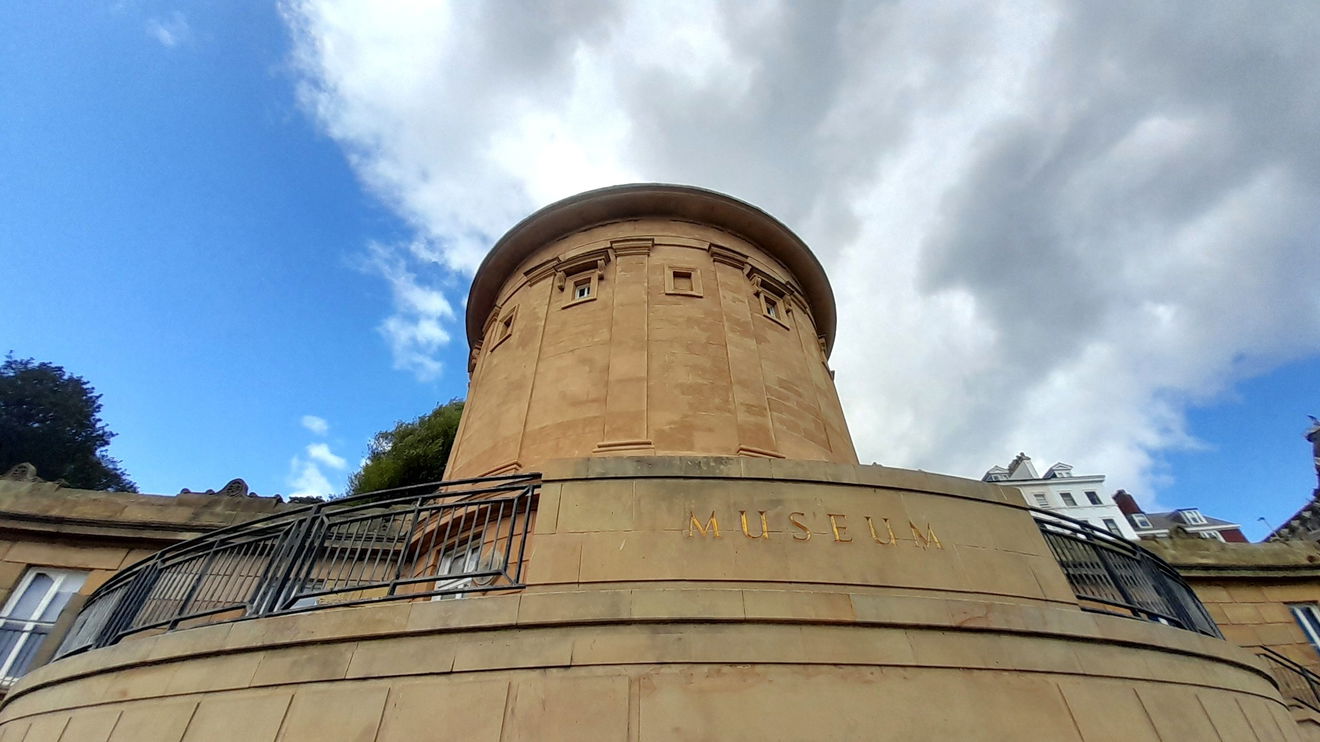
The 'Godfather of Geology' William 'Strata' Smith (1769 to 1839) suggested the singular circular building to the Scarborough Philosophical Society to show the exhibits off to their best advantage. He had seen such a museum in London, and instructed the architect Richard Hey Sharp of York to follow this design.
A Patron of Smith, Sir John Johnstone, donated the Hackness stone to create the building. The Philosophical Society raised the rest of the capital required. We have more about Mr Smith as we go along.
The rotunda is two stories of ashlar sandstone, with the lower level using more rusticated blocks. The wings were added in 1860. There are no windows on the first floor because of the displays in that room, as you will see later.
It was great to spot a fixed sundial on the terrace, you can see it above the railings in the centre of the photo below.
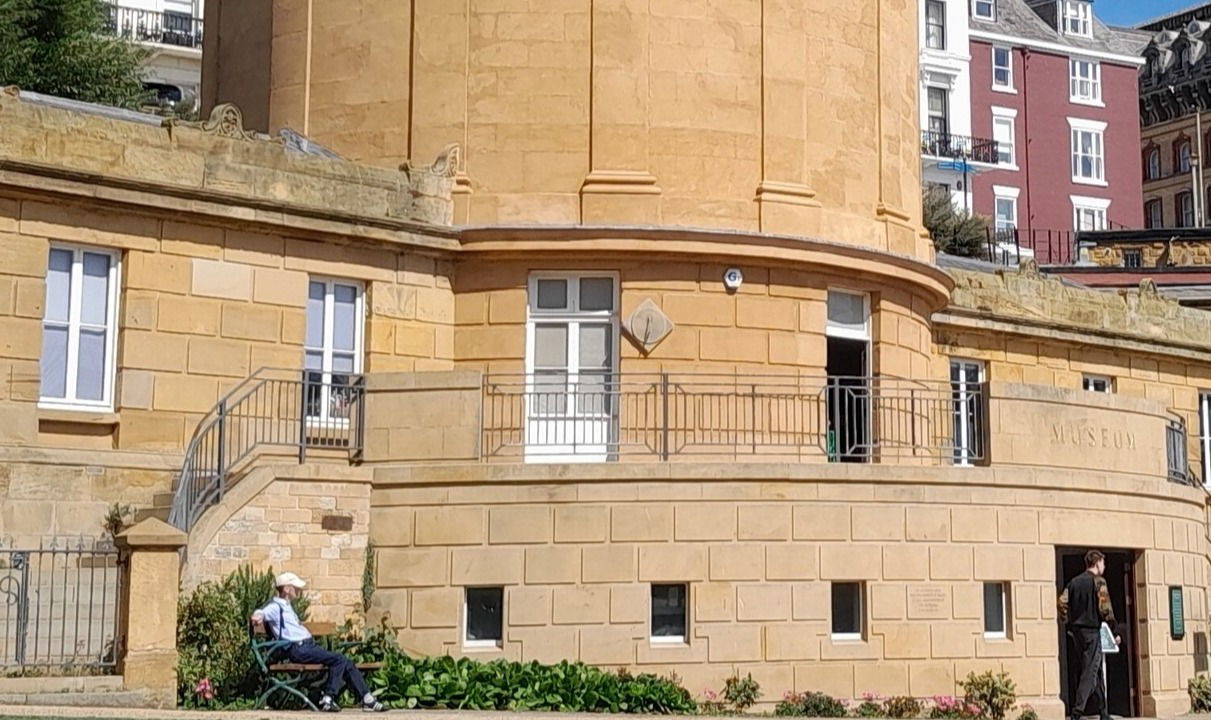
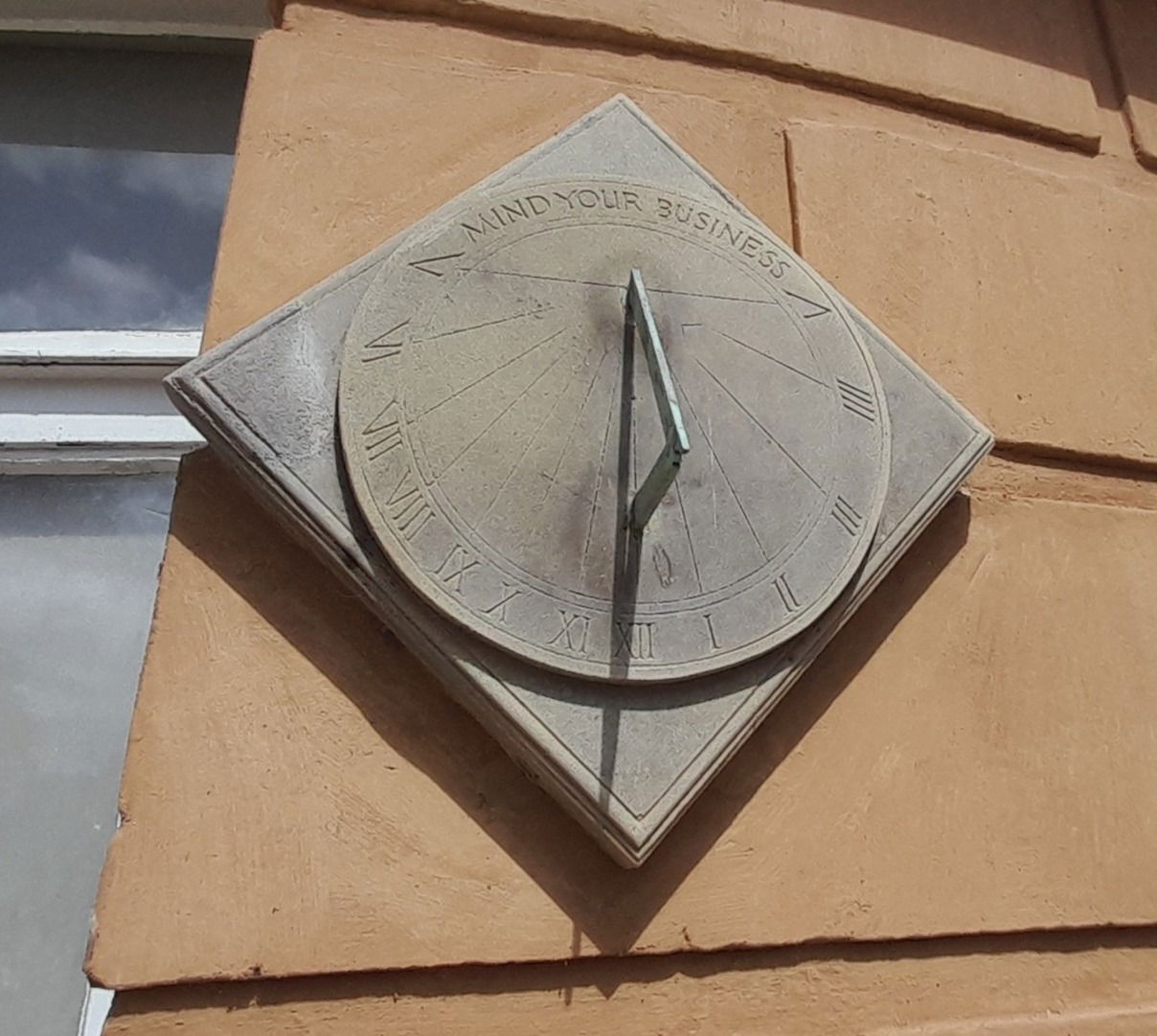
I bounded up the terrace steps and read the Greenwich Mean Time. The motto in English reads 'Mind Your Business', which is considered a witty or moralistic view. It seems to resonate with the museum's ethos to engage with knowledge, focus on learning, and observe nature.
"Sandstone disc on lozenge back. Brass angled strip gnomon. Shows 5am to 5pm in hours. Numerals in line with hourlines and read from outside the dial. Uses XII and IIII. Delineation is incorrect with the horizon line showing 5am/5pm. Dial came from a school and installed by Civic Society. Surface of dial has been sandblasted."
British Sundial Society
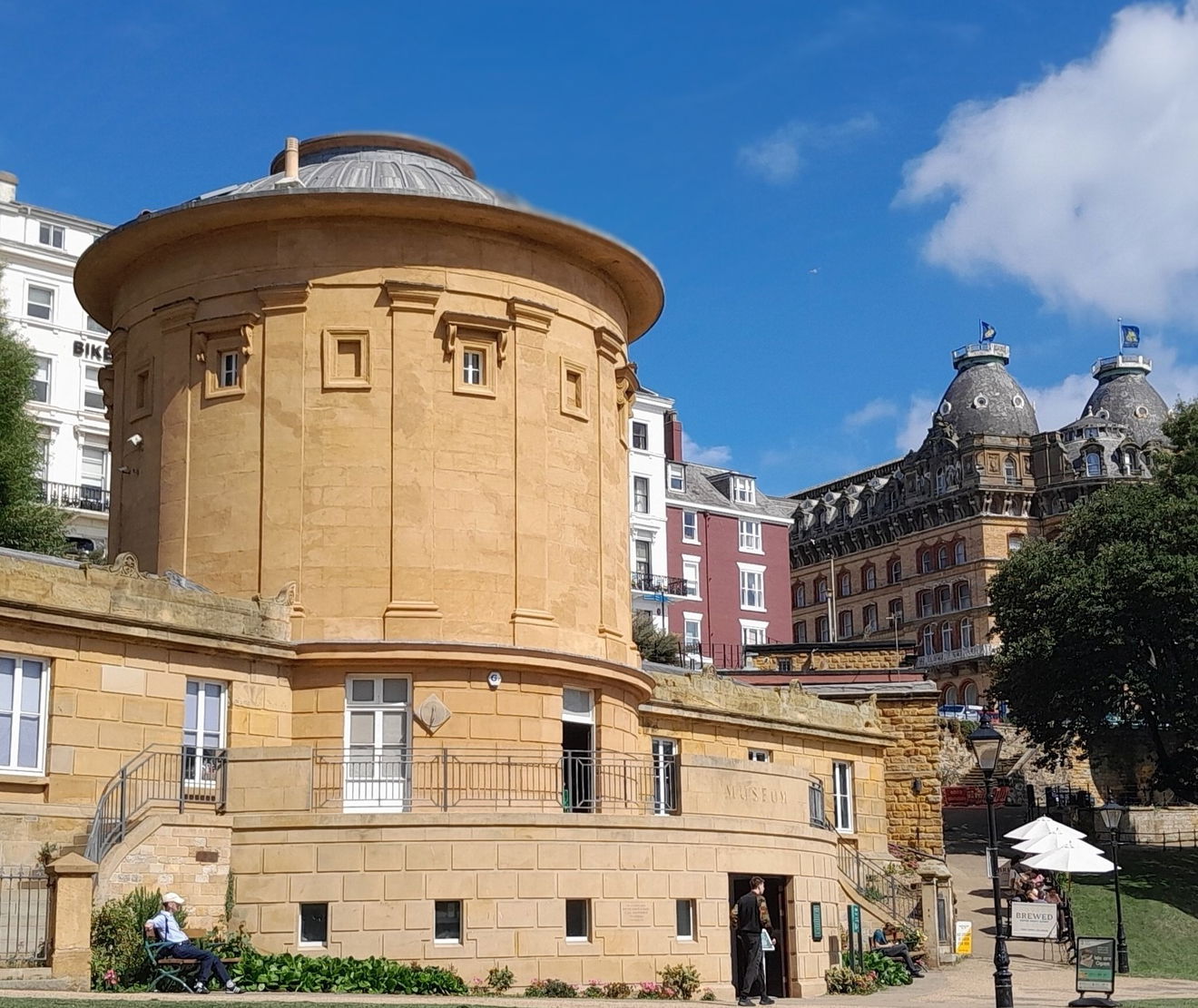
The entrance to the museum was built circa 2006-2008 when the museum underwent a renovation. The existing domed roof was recovered with lead. All in keeping with the original building.
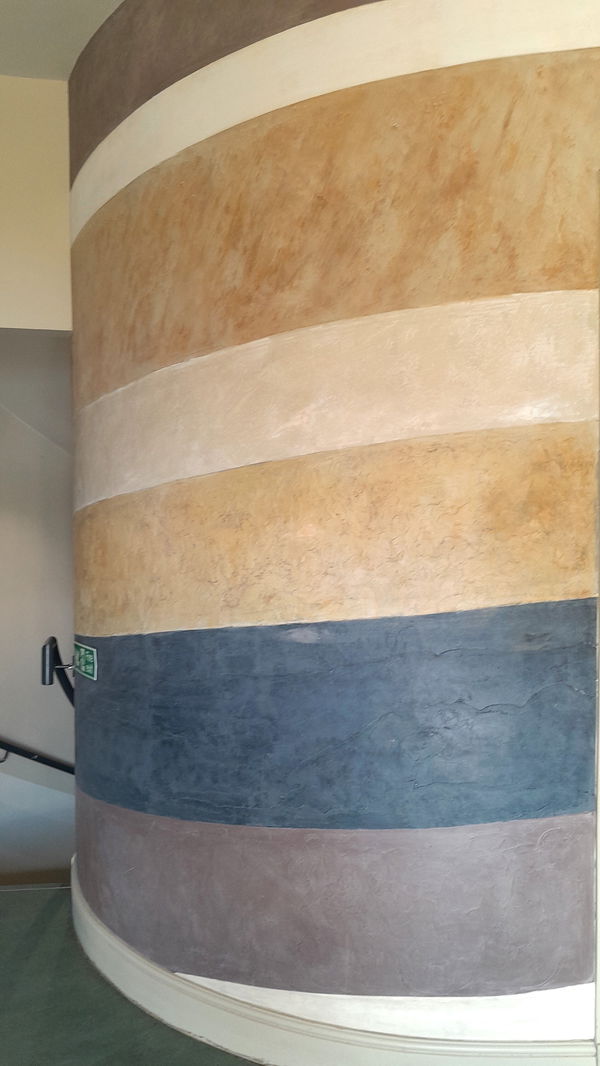
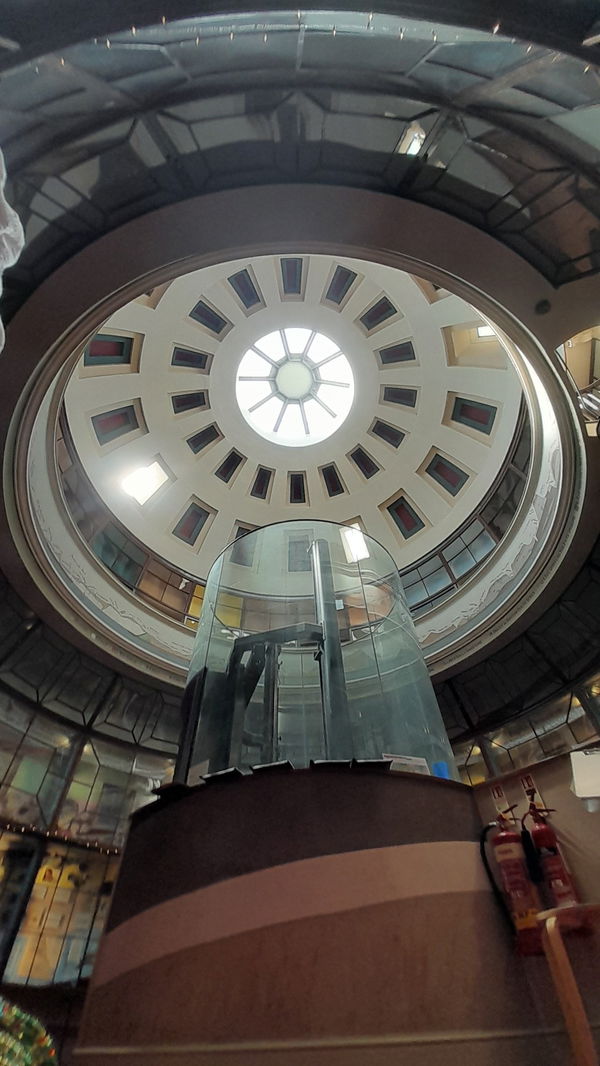
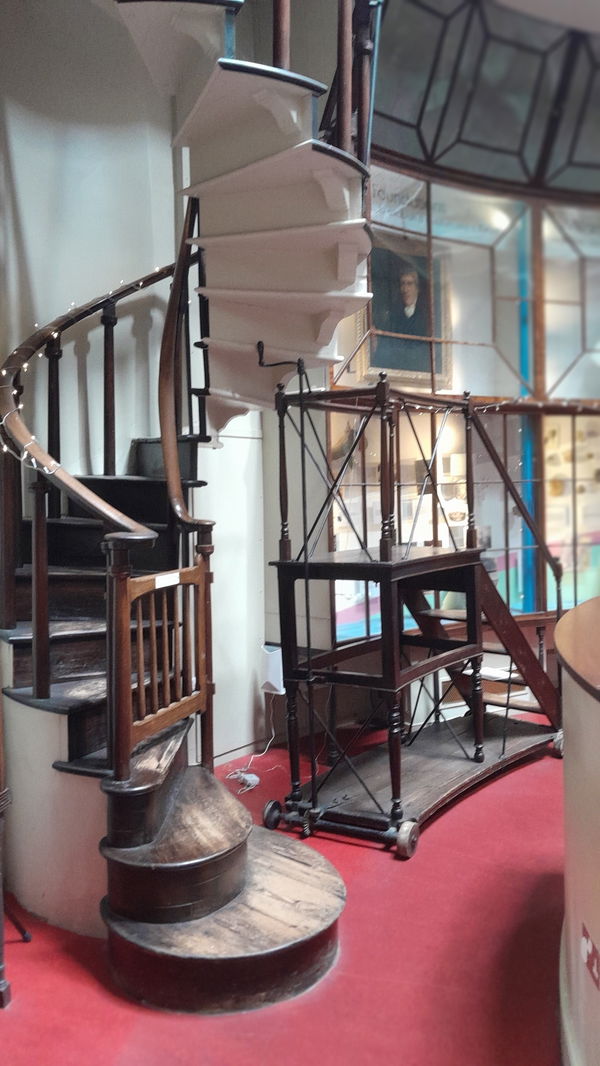
The centre spiral staircase inside was removed (it is stored somewhere) and a lift was installed. The walls around it have a modern geological touch.
Our first encounter was William 'Strata' Smith's astonishing masterwork, the first geological map of England, Wales, and parts of Scotland. The coastline of Yorkshire has an abundance of geological interest.
“Smith's pioneering work established that geological strata could be identified and correlated using the fossils they contain. Smith came to Scarborough after his release from debtors' prison."
Wikipedia
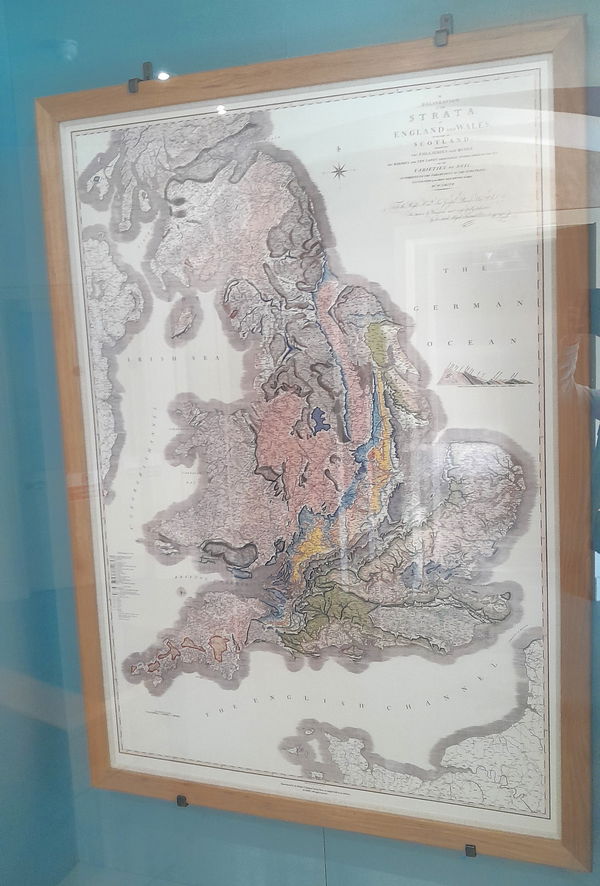
This map and others he made were invaluable to agriculture and mining fraternities. Smith's work is still influential today.
There is an installation, which pays homage to it in Durham City, It is called What Lies Beneath Us.
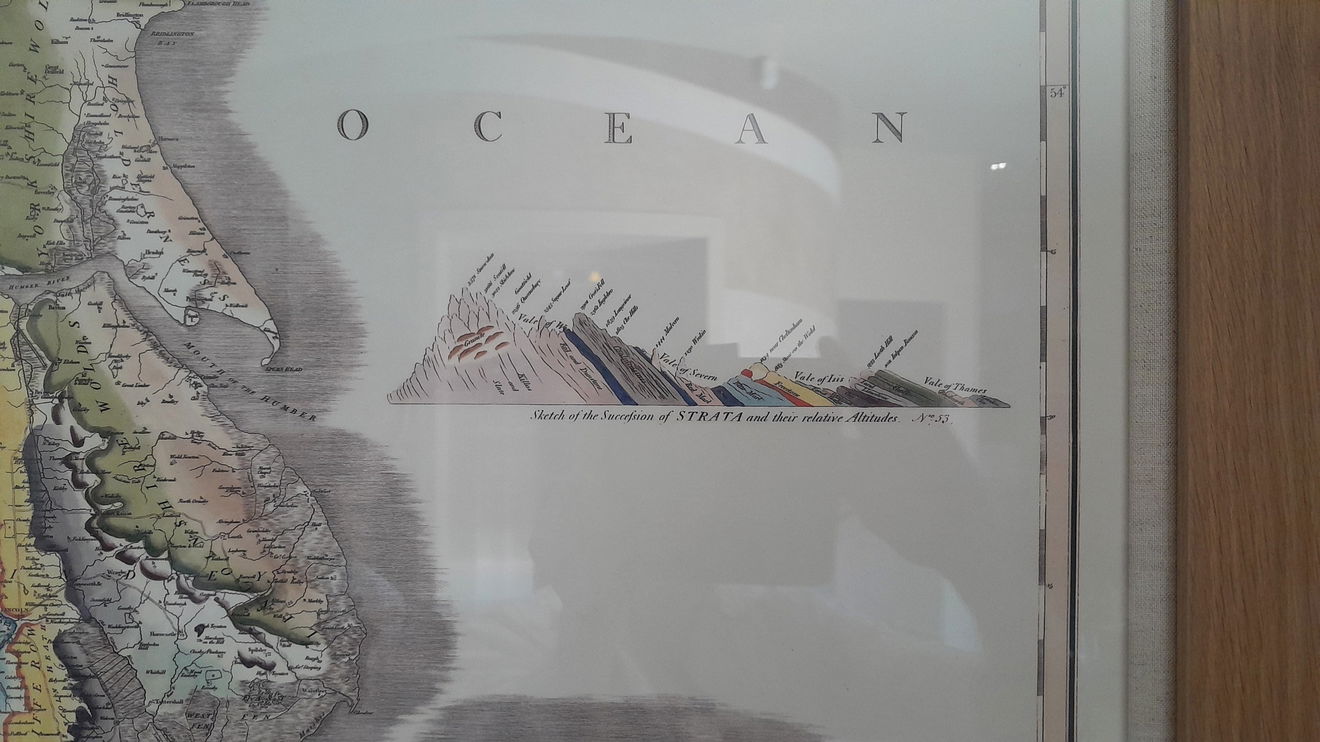
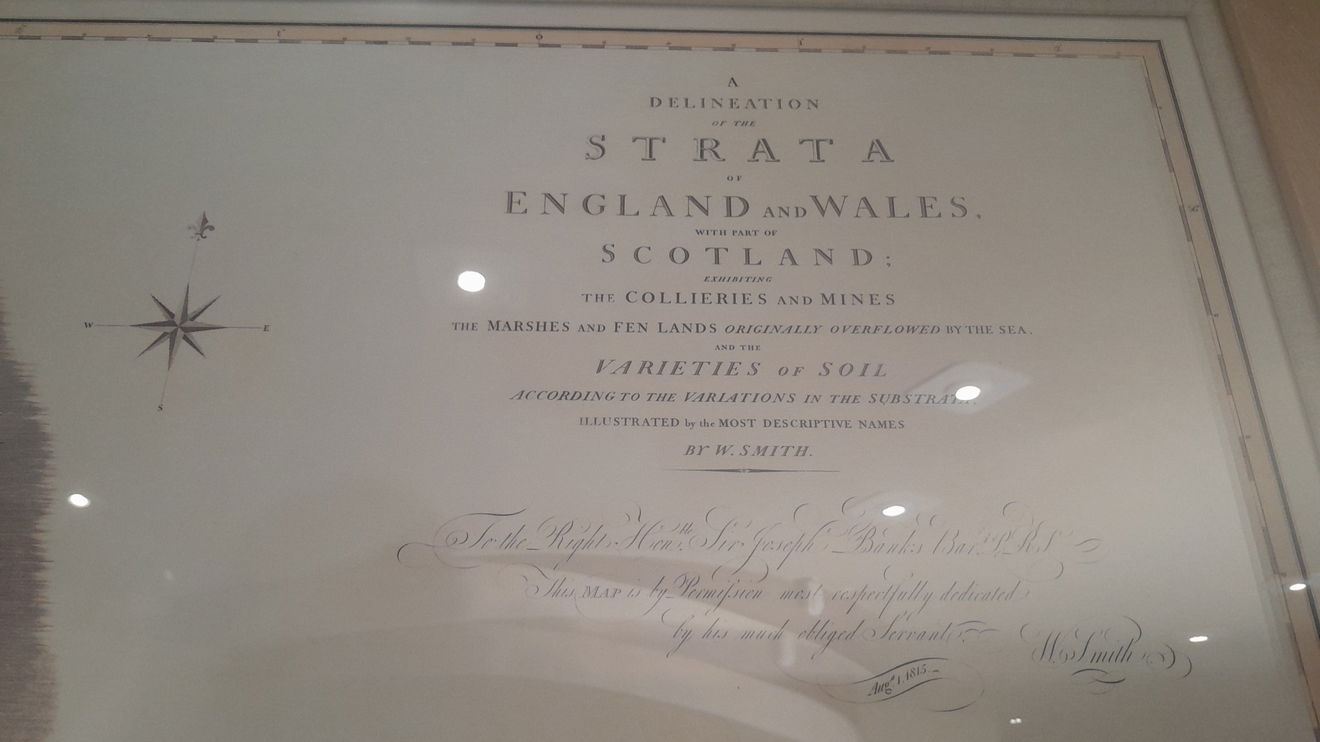
William Smith formulated two laws:
The Law of Superposition, which was first proposed by Danish scientist Niels Steensen (1638 to 1686), when it was believed that fossils grew in the ground.
The law of superposition [..]. In its plainest form, it states that in undeformed stratigraphic sequences, the oldest strata will lie at the bottom of the sequence, while newer material stacks upon the surface to form new deposits over time.
Wikipedia
The other is the Law of Faunal Succession.
The principle of faunal succession, [..] these fossils succeed each other vertically in a specific, reliable order that can be identified over wide horizontal distances. A fossilized Neanderthal bone (less than 500,000 years old) will never be found in the same stratum as a fossilized Megalosaurus (about 160 million years old), [..] This allows for strata to be identified and dated by the fossils found within.
Wikipedia
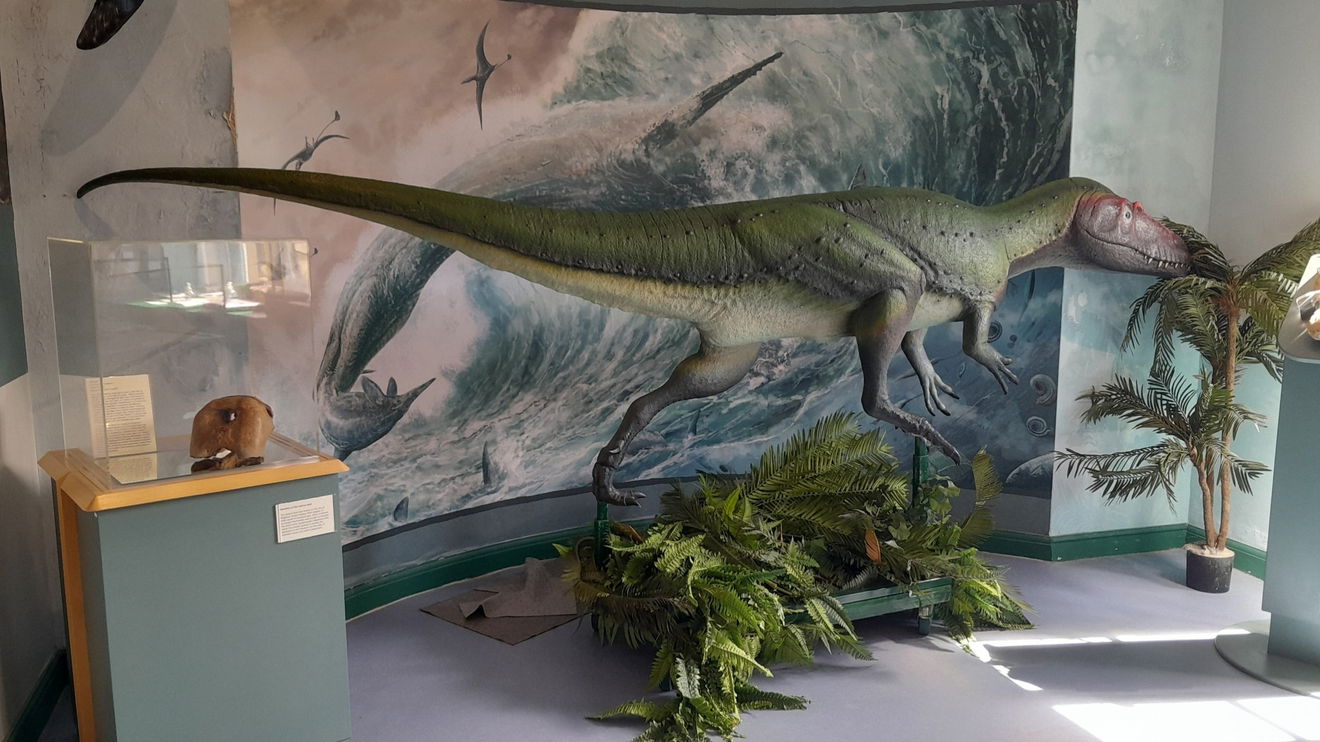
Here is a Megalosaurus below.
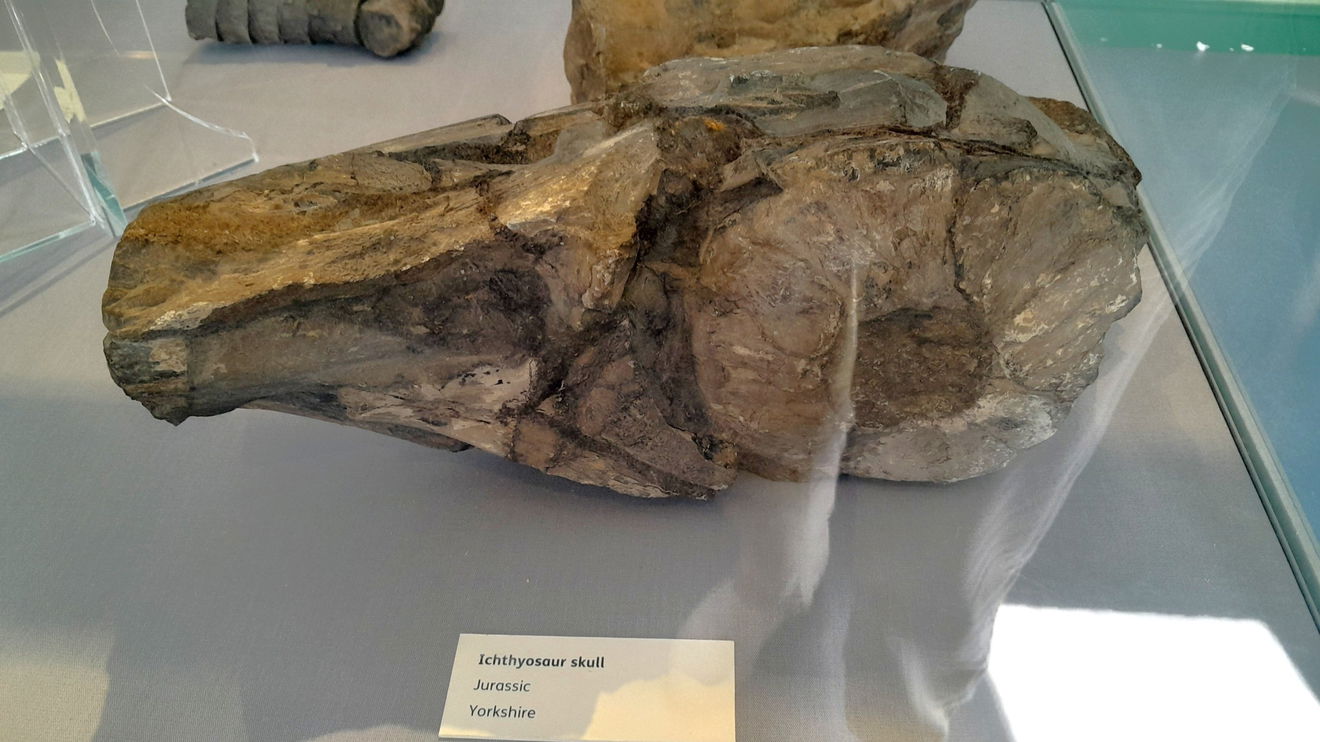
There is also an Itchysoreass and I can now remember the name! How do I know, well, in one of the drawers that you are invited to look in, there is a finely drawn picture dated 1834 by Thomas Hawkins (1810 to 1889) called 'Memoirs of Ichthyossuri and Plesiosauri' from a book what he wrote. He drew this from his collection of fossils and believed that they could be pre-Adamic beings.

For young and old fossil finders, this should inspire many to go hunting, as there are many specimens here from Yorkshire's dinosaur coast.
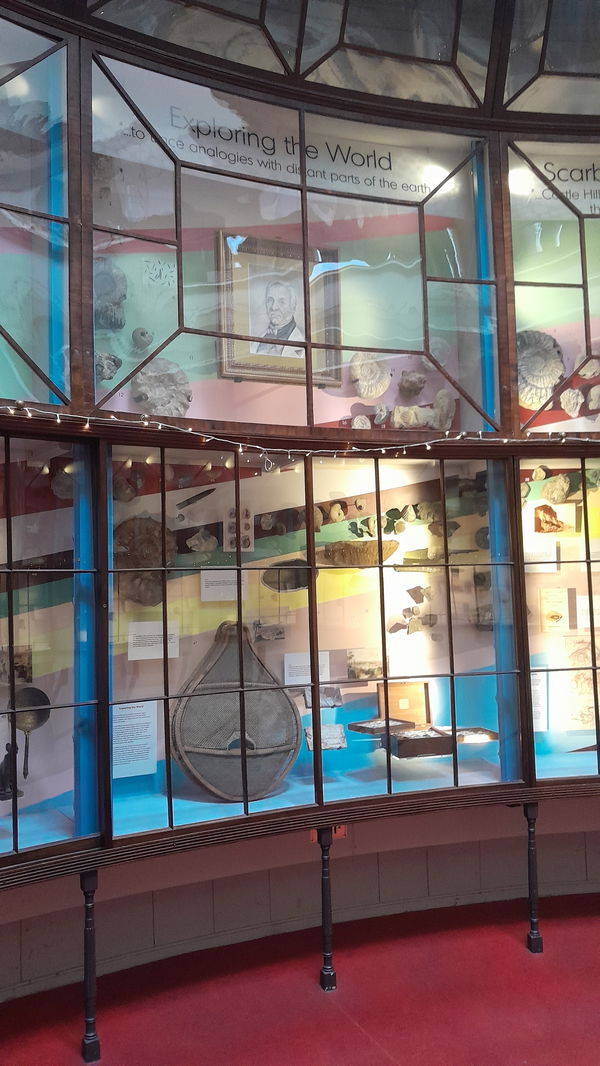
The second floor has no windows as there are bespoke-made wall-to-wall cabinets that date back to 1850. The cabinets have elegant legs and thin bars of veneered Mahogany for the glass. If, like me, you struggle to read smaller printed material, it is made worse here by the Georgian glass that distorts the writing. I should have brought my glasses!
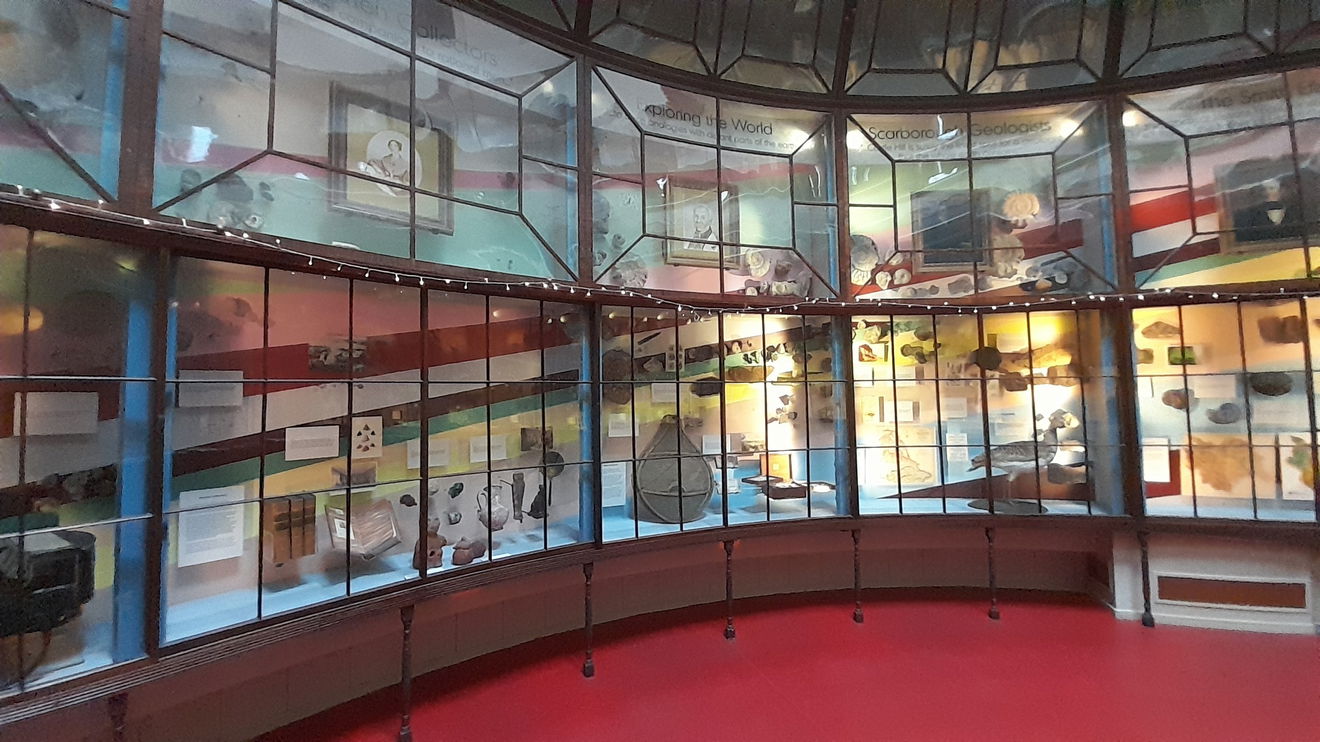
There is an eclectic mix of artifacts, and there should be something to pique your interest.
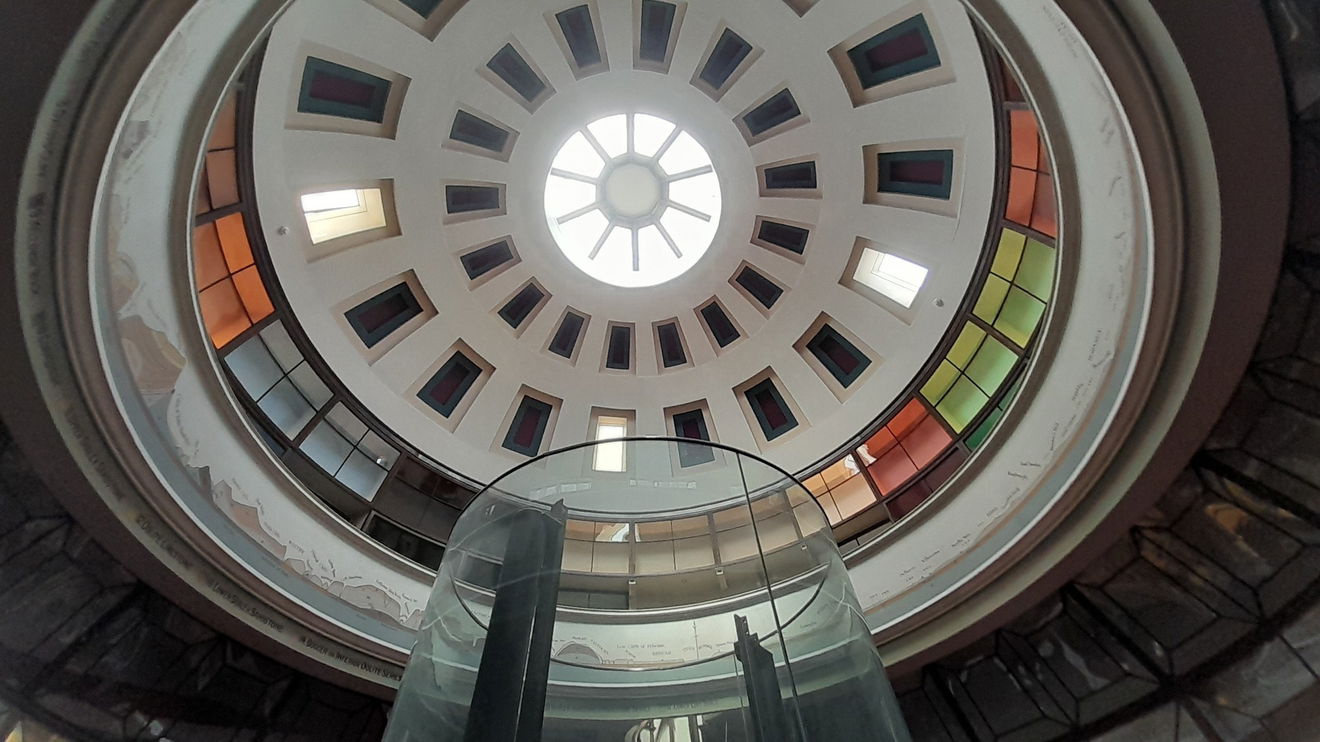
The original stairs have been removed and a lift installed. I tried to capture the wonderful dome ocular. In doing so, I created a nice Dr Who Tardis impression.
A frieze of geological strata runs around below the cornice, which was created by the nephew of Mr Smith, John Philips.
The library ladder is propelled around by winding a handle affixed to a bar on the platform that you stand on. The handle is attached by a vertical rod to the cogs on the axle of the wheels. Advisably, not to be used by the public. The spiral stairs were also out of bounds.
The west wing was closed on our visit due to water ingress, and we did not see Britain's best-preserved Early Bronze Age skeleton, 'The Gristhorpe Man'.
Just to note, it is also labelled as Rotunda Museum, Museum of Geology and Coastal Heritage and you may also find it is called Rotunda, The William Smith Museum of Geology. Rotunda Museum, Scarborough, gets you there no less.
We thought it was a grand little museum and it is a yearly £5 entrance (August 2025), which also includes the Art Gallery in Crescent Gardens.
Next was a coffee at a nearby bistro and a saunter over and under the Cliff Bridge.
Get 2 points if you have visited this place. Already visited by 28 VIPs.
Login to the VIP area to add places to your bucket list, mark them as visited and more importantly see where you rank on the league table.
How To Find Rotunda Museum
Where To Park For Rotunda Museum?
Lat / Long
54.278851, -0.39872
What three words
Parking can be difficult as a popular tourist designation especially in the summer. Closest available is the underground car park at South Bay and Cleveland Way Garage (pay by phone approx £2 per hour). These are just across the Valley Road from the museum.
Contributed by Rosalind Parker
Thank you for reading. I hope it sparks your interest. It’s always a pleasure to get out and explore, whatever the weather. I enjoy uncovering little snippets of information, especially when they’re obscure, amusing, or meaningful. All photos were taken on a mobile phone.
More Places from Rosalind
More Places In Scarborough
Find more fabulous places in Scarborough, North Yorkshire and if you know of a place we haven't listed, then let us know.
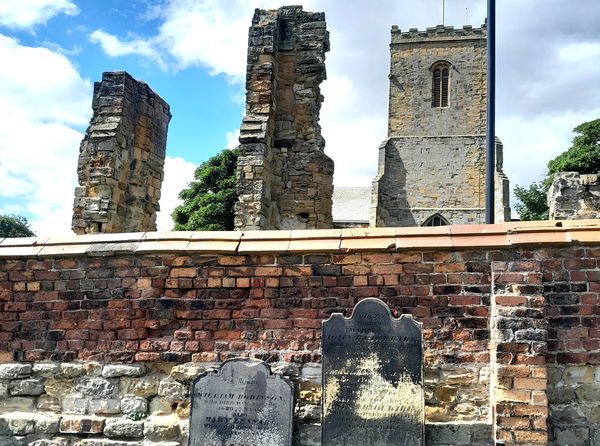
Saint Marys with Holy Apostles Scarborough
Religious Place Scarborough North YorkshireA 12th century church which was the scene of a Roundheads and Cavalier's confrontation and is also the final resting place of Anne Bronte.
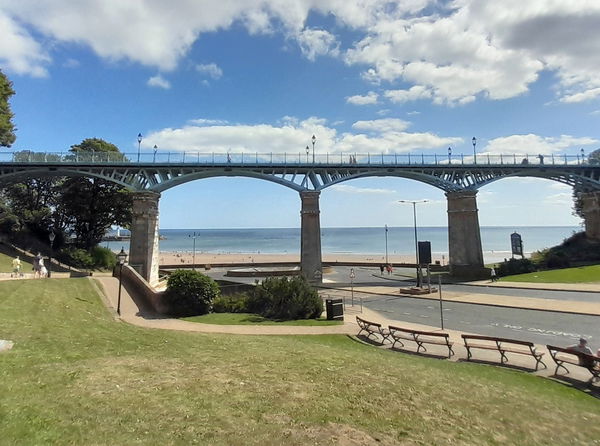
Cliff Bridge
Bridge Scarborough North YorkshireAn imposing Georgian/Victorian footbridge for the gentry to preamble in order to take the spaw waters.
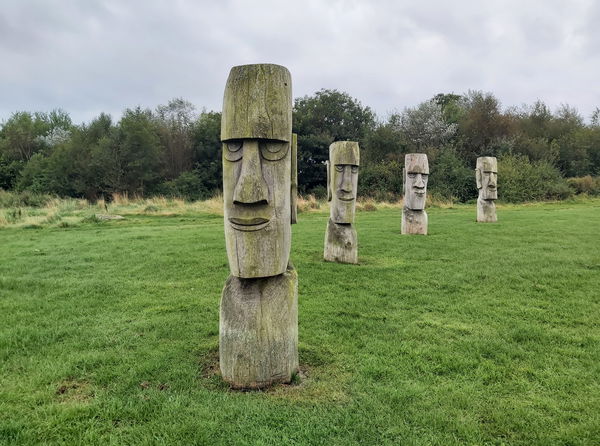
Easter Island Heads In Jonno’s Field
Art Scarborough North YorkshireEight wooden sculptures inspired by Easter Island’s Moai heads in Scarborough.
More Museums
So this museum wasn't enough and you want more? Don't worry we have you covered.
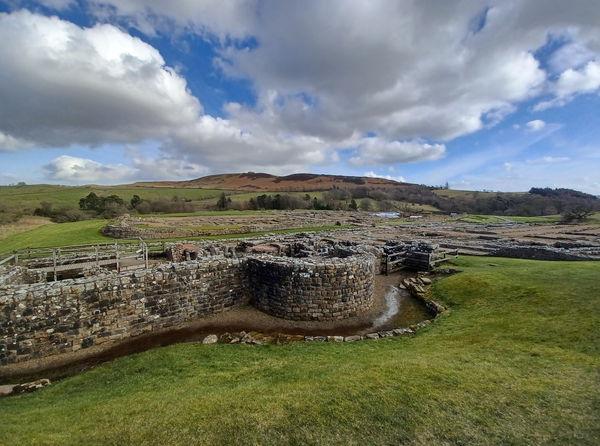
Vindolanda
Museum Hexham NorthumberlandA Roman Fort, surrounding settlement and museum that has been gradually excavated over the past 50 years and the location of some of the most important Roman finds in history.
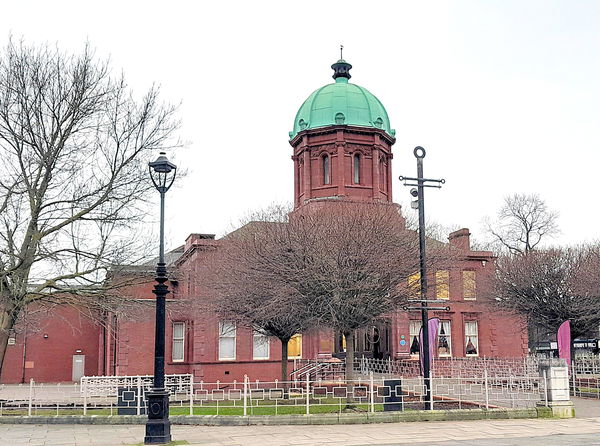
Dorman Museum
Museum Middlesbrough North YorkshireEdwardian Gothic-style museum, featuring local and natural history displays and a ceramics collection.
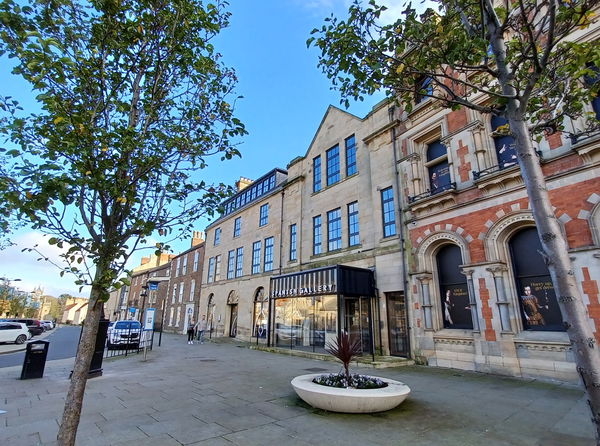
Spanish Gallery and Mining Art Gallery
Museum Bishop Auckland County DurhamTwo fantastic galleries in the heart of Bishop Auckland.
Never Miss A Fabulous Place
If you are afraid of missing out on all the fabulous places we post, or just want to be the first to know, then sign up to the Fabulous North.
Each week we will email you all the brand new places that we visit.
Sign Up To Alerts

Find Us On Facebook
We post all our new places daily on our Facebook Groups page, so join the group today and be notified when we add a new place.
Join Our Facebook GroupRotunda Museum was listed in Museum // North Yorkshire // Scarborough